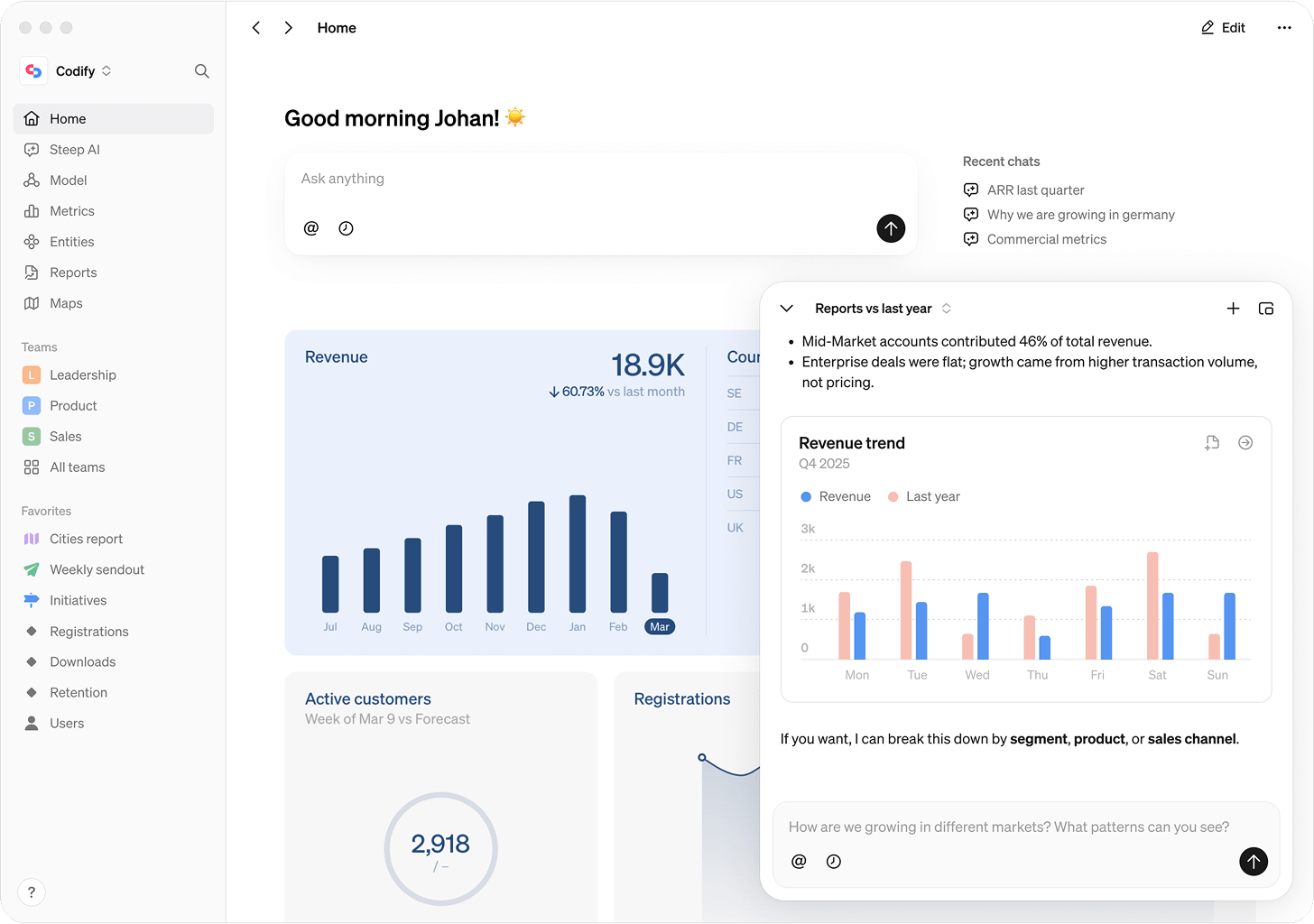
Ask questions in plain language and go from a question to charts, tables, and explanations without leaving your workflow. It is built directly into Steep and available in the mobile app, so you can explore and analyze wherever you are.
Everyone
Everyone in the workspace can use Steep AI to ask questions, analyze data, and explore the semantic model. It has the same permissions as the signed-in member.
Admins
Admins can enable Steep AI and improve results by maintaining a well-defined semantic model. You can also add workspace context in settings, and AI context to modules, dimensions, metrics, and entities.
Getting started
There are a few ways to start using Steep AI, depending on where you are in Steep.
- From the home screen: You can enter a prompt directly from the Steep AI prompt field at the top of the home screen.
- From anywhere in Steep: Click the AI icon in the bottom-right corner to open the chat. This is available across desktop and mobile.
- From a chart: Click on a chart and select Add to chat from the tooltip. This adds context from the chart, including the currently shown metric and time period, so you can continue exploring from there.
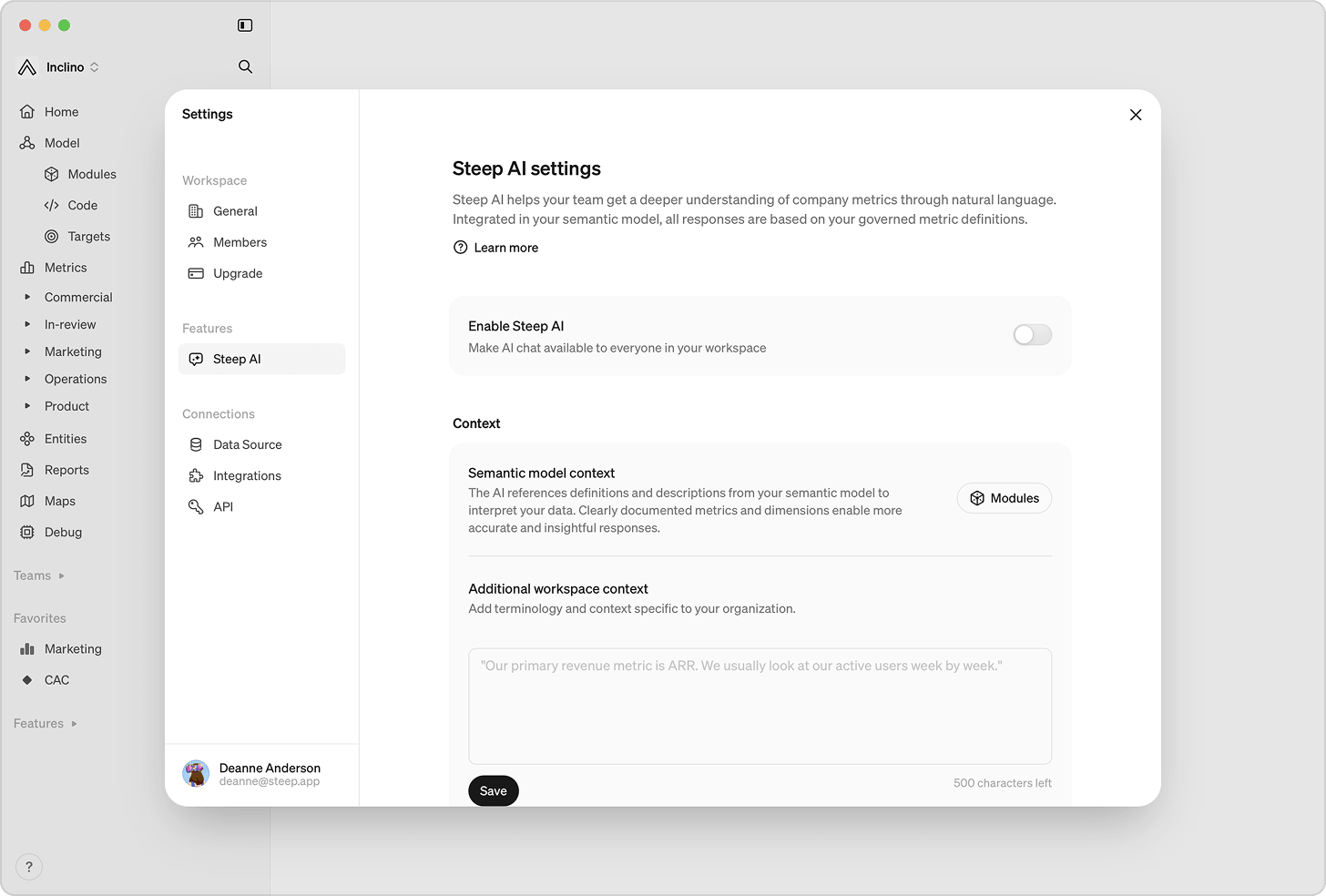
Admins can enable or disable Steep AI for the workspace in Settings → Steep AI by toggling it on or off.
AI model region
Admins can choose where Steep AI's processing runs: United States or EU. Change this at any time in Settings → Steep AI.
The model itself is the same regardless of region — this setting only controls where processing happens.
Add context to the chat
You can give Steep AI more context before asking a question.
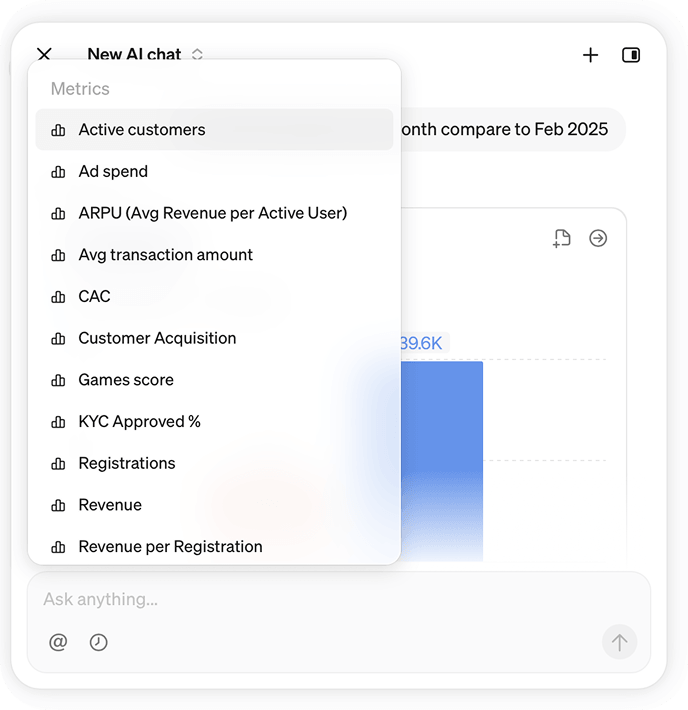
Choose metrics: Click the @ icon and select the metrics you want to analyze.
Add a time period: Click the clock icon and select the time period you want to analyze.
Add context from a chart: Click on a chart and select Add to chat from the tooltip. This adds the metric and time period from the chart.
Add files: Drop in images, PDFs, and text files directly, or add them from the + button. Add one at a time or several together.
Get more relevant answers: Adding context helps Steep AI understand what you are asking about and return faster, more relevant answers.
Model availability
File uploads are available on the United States AI model region. See AI model region below.
Clarifying questions
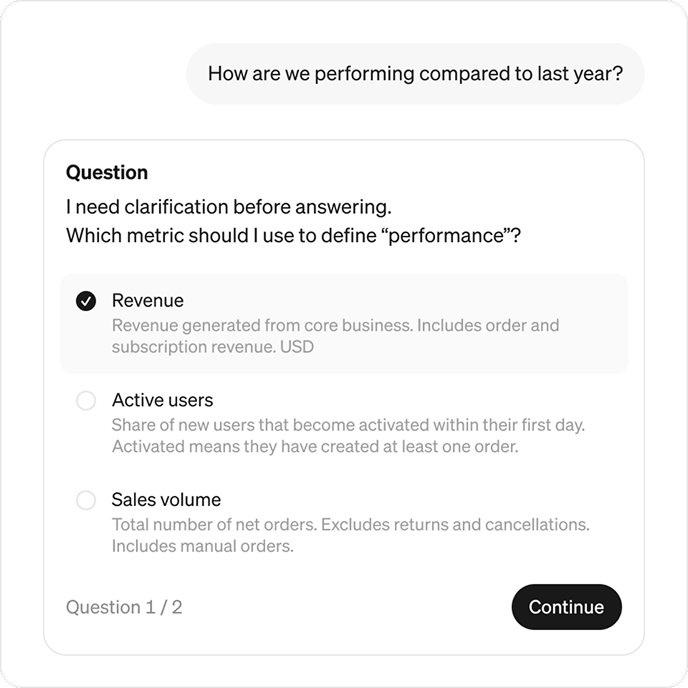
If your prompt is too ambiguous, Steep AI may ask a clarifying question before generating an answer.
This helps narrow down the right metric, dimension, chart, breakdown, or time period so the result matches what you are looking for.
How Steep AI answers
Steep AI can help with everything from quick questions to deeper analysis.
Depending on the question, it can return:
- Charts
- Tables
- Written explanations
- A combination of all three in the same response
Steep AI can also build reports for you, including tables and big numbers.
You can also shape the answer by asking for:
- Filters
- Breakdowns
- Comparisons
- Time grains
- Time periods
From a chart in the chat, you can:
- Open it in Explore using the icon in the top-right corner
- Save it to Reports using the icon in the top-right corner
You can also save tables from the chat to Reports.
Chat history
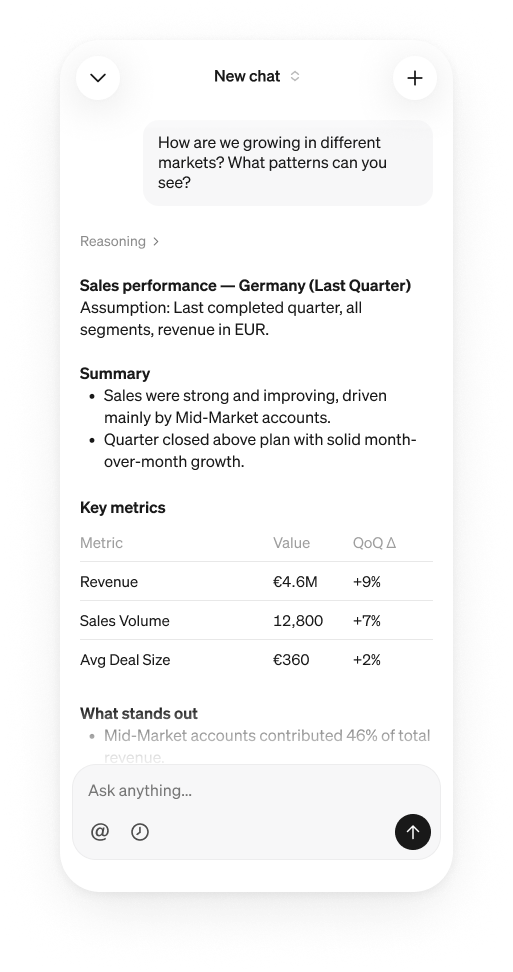
Steep AI keeps your chats organized, so you can continue existing threads or start new ones whenever you need to.
Continue where you left off: Steep AI keeps your chats across desktop and mobile, so you can pick up where you left off on either device.
Start a new chat: When you open Steep AI, it returns to your most recent chat. To create a new one, click the + button at the top of the chat.
Switch between chats: You can have multiple chats at the same time. Click the chat name at the top of the window and select the one you want to open.
Rename or delete a chat: Click the three dots (...) next to a chat to rename or delete it.
Use Steep AI across Steep
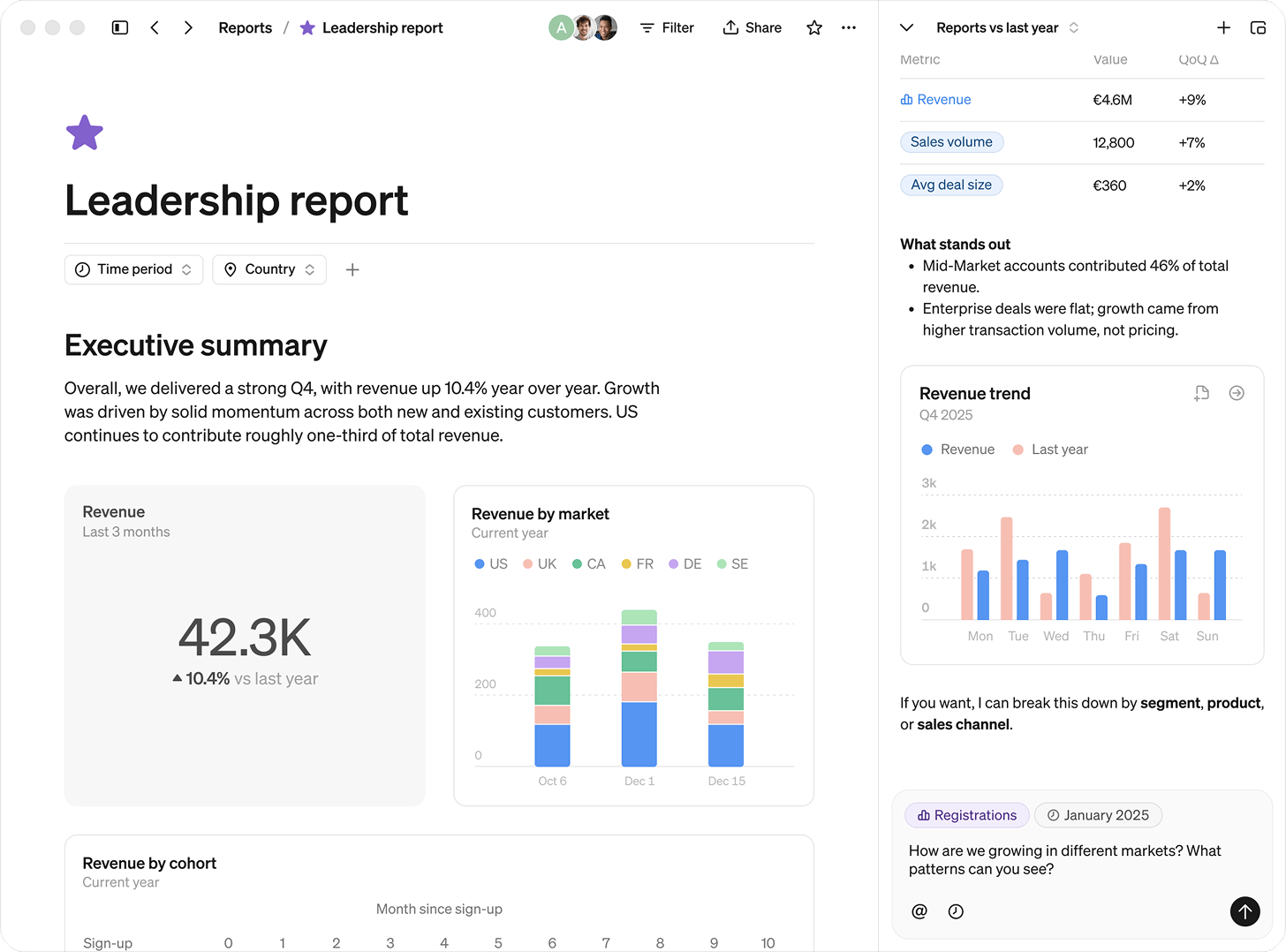
You can keep the same chat going as you move between different parts of Steep.
Access it wherever you work: Steep AI is available throughout the product.
Keep your context: As you move between views, the chat stays with you so you can continue the same chat.
Take action from the chat: You can add charts to the chat, open results in Explore, and save charts to Reports as you go.
Set up your workspace
Steep AI works out of the box when you have defined metrics. A strong semantic model is the most important foundation for good answers. For the best results, we recommend:
- Using clear metric and dimension names
- Writing descriptions for metrics, dimensions, and modules
- Naming things the way your organization talks about them
- Adding AI context to your semantic model and workspace
Improve answers with AI context
Steep AI, and AI apps connected through Steep's MCP server, already use everything defined in your semantic model, such as metric names, descriptions, definitions, and time grains. AI context is extra information you add specifically for AI agents, so they understand how your organization talks about and uses its data.
Types of AI context
- Synonyms: Other names people use for something, such as abbreviations or terms in other languages. For example, a Revenue metric could have the synonyms
sales, turnover. - Agent instructions: Guidance that is only shown to AI agents, for things people know that your definitions don't capture. For example, "A lower number is better for this metric" or "We usually look at this metric weekly."
- Examples: Questions a metric answers, phrased the way people ask them. For example, "How much did we sell last month by country?" Only available for metrics defined in code.
- Additional workspace context: Terminology and context about your organization as a whole. Admins add it in Settings → Steep AI.
Where to add it
In the app, you find these fields when you create or edit a module, dimension, metric, or entity. If you define your semantic model in code, use the synonyms and agent_instructions fields, and examples on metrics. See the code reference.
Best practices for writing AI context
- Add it once, at the right level: Put AI context on the item it applies to, and try not to repeat it elsewhere. If it applies to everything in a module, add it to the module. If it's specific to one dimension, add it to the dimension. If it applies across your whole organization, add it to workspace context.
- Use synonyms for other names: If people call something by another name, such as an abbreviation or a term in another language, add a synonym.
- Use agent instructions for what people know: Add knowledge that lives in people's heads but isn't already in the definition. For example, "Always split this metric by sub-brand", "A lower number is better for this metric", or, on a module, "Our company KPI is Revenue, so use it instead of Net revenue by default."
- Keep it short: Your semantic model already gives agents a lot of context, so a sentence or two is usually enough.
Who can see it
Unlike names and descriptions, AI context isn't shown to members directly, but agents may refer to it in responses.
Trust and reasoning
Answers are grounded in your semantic model: Steep AI uses your semantic model, including metadata and metric definitions, together with Steep's query engine to answer questions.
Relevant metrics are linked in the chat: When Steep AI refers to a metric, it links to it directly in the chat so you can open it in Explore to analyze the underlying metric.
Raw database tables are not exposed to the model: Steep AI does not have direct access to the raw data tables in your database.
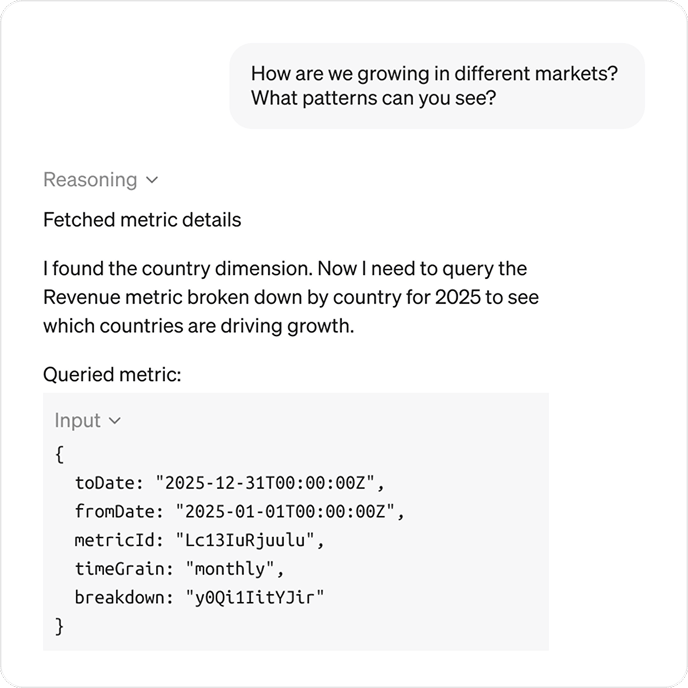
You can review how an answer was created: Expand the reasoning to see more detail about how Steep AI arrived at a result.
Current limitations
Steep AI is evolving quickly, and some limitations still apply:
- Big number blocks are not shown in the chat, but Steep AI can add them to reports
- Questions about help center content are not supported
- Questions about entities are not supported
Frequently asked questions
Will Steep use my data to train AI models?
No. Steep does not use your data to train AI models. For more details on our security practices related to Steep AI, see our security page.
Which model does Steep AI use?
Steep AI is powered by Anthropic's latest models.
What data does Steep AI have access to?
Steep AI has access to your full semantic model, including metadata and metric definitions. It generates responses using Steep's query engine.
Does Steep AI have access to our raw database tables?
No. Steep AI does not have direct access to the raw data tables in your database.
How is Steep AI priced?
Steep AI is currently available to paying customers at no additional cost, for reasonable usage.